|
By QUINCY LIANG
 After
more than two decades of effort, Taiwan has become the largest supply source of
golf equipment and accessories in the world. The sector has consistently been
Taiwan's top export category in the sporting-goods market over the last decade,
with the exception of last year, when it was eclipsed by fitness equipment. After
more than two decades of effort, Taiwan has become the largest supply source of
golf equipment and accessories in the world. The sector has consistently been
Taiwan's top export category in the sporting-goods market over the last decade,
with the exception of last year, when it was eclipsed by fitness equipment.
Facing intense competition from low-cost rivals in mainland
China, golf-equipment makers in Taiwan have been forced to move either upmarket
or offshore. Already, local producers are boosting margins by developing more
high-end products with innovative designs and advanced materials. Others are paring
costs by moving production to cheaper sites, especially in mainland China.
The strategy has paid off in higher sales over recent
years. Golf-equipment suppliers enjoyed an especially good year in 1997, in large
part thanks to the golf mania sparked by U.S. golfer Tiger Woods. Yet sales dipped
again in the following year as Woods' performance lagged and an abnormally rainy
season in North America kept golfers off the links. The slump was exacerbated
by the recession in Southeast Asia and Japan.
Taiwan
Exports of Golf Equipment and Accessories*
Unit: US$1 million
|
|
|
|
1999 |
1998 |
|
|
|
Export Value
|
|
364.6 |
386.6 |
|
|
|
Crowth Rate**
|
|
-11.8% |
-20.2% |
|
|
*Including golf carts and vehicles, golf clubs,
balls, and other golf equipment
** Compared with previous year.
Source: ROC Directorate General of Customs.
Since bottoming out in 1999, Taiwan's golf-equipment
makers have regained some of the lost ground. Statistics released by the Directorate
General of Customs under the Ministry of Finance show that Taiwan exported about
US$338.4 million worth of golf equipment and accessories in 2000, up about 1%
from the 1999 figure, though still off 30% from the US$484.7 million registered
in 1997.
Despite the slower gains, the golf-equipment sector managed
to grab more than 25% of Taiwan's total sporting-goods exports last year. Major
export items in the line were golf-club heads and carbon-fiber shafts.
The recovery of Taiwan's golf-equipment sector may be
partly ascribed to the continued efforts of manufacturers here in improving the
look and performance of their products. Suppliers have rolled out a host of innovative
products in recent years, many of them featuring patented designs or incorporating
special materials that low-cost rivals overseas are hard-pressed to match. 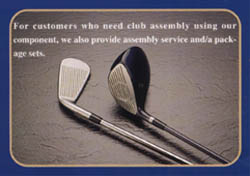
Head Specialist
One such innovator is Dynamic Precision Industry Corp.,
which has grown steadily over the last three decades by specializing in golf-club
heads and components. Unlike most other local suppliers, the ISO 9002-certified
firm only makes golfing products, enabling it to develop expertise in the line.
Established in 1973 with a capitalization of US$15 million,
Dynamic currently has four factories in Taiwan and mainland China, as well as
branch offices in Japan and Germany. The company employs about 300 people worldwide
and has a monthly capacity of 300,000 club heads. Last year, it posted revenue
of US$26.1 million.
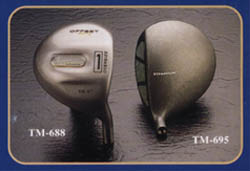
Dynamic's Ta Liao plant in southern Taiwan produces stainless-steel,
wood, iron, and composite-material club heads; its plant in Pingtung County manufactures
stainless-steel iron and putter heads; and its Tafa plant in Kaohsiung County
turns out stainless-steel casting parts, titanium club heads, and titanium casting
parts. The company also makes stainless-steel iron, wood, and putter heads in
Guangdong Province, mainland China.
Dynamic prides itself on its expertise in material processing,
state-of-the-art production technology and equipment, and comprehensive range
of materials, used to provide top-quality products to global markets. The company
claims that it can do all of its processing in-house. Materials used by the company
in its golf-club heads include stainless steel, titanium, and alloys such as aluminum-bronze.
Thanks to its reputation for quality, Dynamic has successfully
expanded into some the world's toughest export markets, including Europe, the
U.S., Canada, Australia, and Japan, where most of its sales are concentrated.
Forging Ahead
Established in 1994, Superalloy Industrial Co., Ltd.
is an ISO 9002- and QS-9000-approved expert in forging aluminum-alloy, titanium-alloy,
super-alloy, and nonferrous-metal components.
The company recently earned the Rising Star Award from
the Small and Medium Enterprise Administration of the Ministry of Economic Affairs--an
award presented to local small- to medium-sized enterprises in recognition of
achievements in international competitiveness and market expansion.
Currently, Superalloy commands about 25% of the U.S.
market for forged titanium-alloy golf-club heads. The company developed production
processes for titanium-alloy components in early 1995. Since then the firm has
won numerous patents worldwide for its technological innovations in the line,
including patents for its two-piece and three-piece form-forging techniques. The
company has also patented technology for making titanium- and copper-alloy club
heads.
Drawing on its advanced capabilities in both materials
and production technology, Superalloy has diversified into the defense, aerospace,
transportation, petrochemical, power generation, and semiconductor facility industries
in the past few years. The company is an approved supplier of components to Taiwan's
Ministry of National Defense. It is also qualified to supply aluminum-alloy wheels
to General Motors (GM) of the U.S., as well as key parts and components for 16G
(gravity) in-flight passenger chairs.
With business steadily increasing, Superalloy moved
to a new factory at the Yunlin Technology Industrial Park last year. The plant
is equipped with the latest machinery for forging, forming, machining, coating,
and polishing a wide range of materials, such as pure titanium, titanium alloys,
aluminum alloys, nickel alloys, stainless steel, copper, copper alloys, carbon
steel, magnesium, and magnesium alloys. The company
is currently capitalized at US$5.9 million and has 100 employees.
High-Performance Graphite Shafts
Established in 1988, Paderson specializes in the production
of composite-material golf-club shafts. In Taiwan, the company ranks as one of
the top-two shaft makers in terms of export value.
"Unlike most local shaft makers that mainly produce
on an OEM basis," says company president Patrick C. T. Hsu, "our company mostly
supplies products on an ODM (original design manufacturing) basis."
Hsu claims that Paderson has developed the most advanced
metallic-fiber composite materials for high-end golf-club shafts. The fibers used
in the shafts are a combination of nickel- and copper-coated fiber pre-prags on
a graphite fiber base.
Hsu says that his company is the world's first maker
of Diamet (diamond-woven metallic fiber) shafts. The Taiwan company supplies its
Diamet shafts to several world-famous brands such as Adams, Orlimar, and Dunlop.
"Products made with Diamet technology have several unmatched
advantages over other kinds of shaft," Hsu indicates. "They provide both the benefits
of graphite and steel shafts. They are made with a filament-winding process and
use nickel to give the weight and consistency of steel with the shock-absorbing
qualities of graphite. The metals also allow for an unlimited combination of torque,
flexibility, weight, and balance, providing a club shaft that can fit any golfer's
swing."
"The combination of nickel and copper increases the
weight of the shafts without affecting performance. It also provides some of the
consistency and feedback generally associated with steel shafts. "Due to these
advantages," Hsu says, "we feel the Diamet series is the first batch of graphite
shafts that truly performs to the level of the best steel shafts." Steel-shaft
clubs are the first choice of most skilled golfers and are preferred by over 99.9%
of professional players, Hsu adds.
In addition to its Diamet series, Paderson uses high-precision
machinery to crank out a full range of high- to middle-end graphite shafts. Hsu
says that his company uses imported computerized-production equipment to assure
the best quality and precision for its products.
"From the outset," says Hsu, "we aimed to become a high-end
ODM maker in this line. Our commitment to this objective is seen in our large
research team, which accounts for about 10% of our staff." Hsu adds that Paderson
has the greatest number of patents for new materials, shaft design, and processing
methods in Taiwan.
Paderson has set up a subsidiary in the U.S., Rapport
Composite Co., to handle dealer programs and OEM/ODM services in that market.
The company also operates a plant in Taiwan and one in mainland China as well.
It plans to set up another plant in Taiwan in the near future to strengthen the
company's development capability.
Paderson turns out between three million to four million
shafts annually. The company currently supplies over one thousand types of product
to major customers around the world, with half of its exports destined for the
U.S. and the other half going to Europe, Japan, and Australia.
|